You're probably not asking this because you want a number for its own sake.
You're asking because there's a decision sitting behind it. Whether the stairs still make sense. Whether you could buy the next place before this one sells. Whether the kitchen is worth redoing, or whether you should just go.
The number matters because of what it lets you do next.
So here's the honest version of the answer for an Alexandria, Virginia home, including the parts that most "instant home value" pages leave out.
The short version
- Three different numbers claim to be your home's value: your city assessment, an online estimate, and the market value a buyer will actually pay. They are not the same number, and they're often not close.
- Your Alexandria assessment is dated January 1, so by the time you list in spring or summer, it's reflecting sales that closed roughly a year before you're reading it.
- Online estimates are built for homes that are already listed. On homes that aren't on the market, they have much less to work with, and Alexandria's older, no-two-alike housing stock is exactly the kind they handle worst.
- A comparative market analysis (CMA) is a person choosing the right comps, adjusting for what makes your house different, and telling you what a buyer will pay this month. It takes about a week.
Three numbers that all claim to be your home's value
Most of the confusion in a first pricing conversation comes from mixing these up.
The number | Who makes it | What it's actually for | How current it is |
|---|---|---|---|
Assessed value | City of Alexandria assessors | Calculating your property tax bill | Dated January 1 each year, based on prior sales |
Automated estimate | A software model, from public records and listing data | Giving a rough starting point at scale | Updates often, but only from data it can see |
Market value | Buyers, through their offers | What you actually walk away with | Right now, and it moves |
An appraisal is a fourth thing, and it usually shows up later. That's a licensed appraiser hired by the buyer's lender to protect the loan, after you're already under contract.
Your assessment is a tax number, not a sale price
Alexandria reassesses every year, and the notice that lands in your mailbox is the single most common thing sellers anchor to.
For CY2026, the citywide average residential assessment came in at $757,706, up 3.81% from the year before, according to the assessment figures the City presented to Council in February 2026 (ALXnow). Split by property type, the gap is wide. Average single-family assessments reached $1,045,750 and average condominium assessments $460,185. For comparison, the City's own published CY2025 figures were $729,925 residential, $1,001,336 single-family, and $447,612 condominium (City of Alexandria).
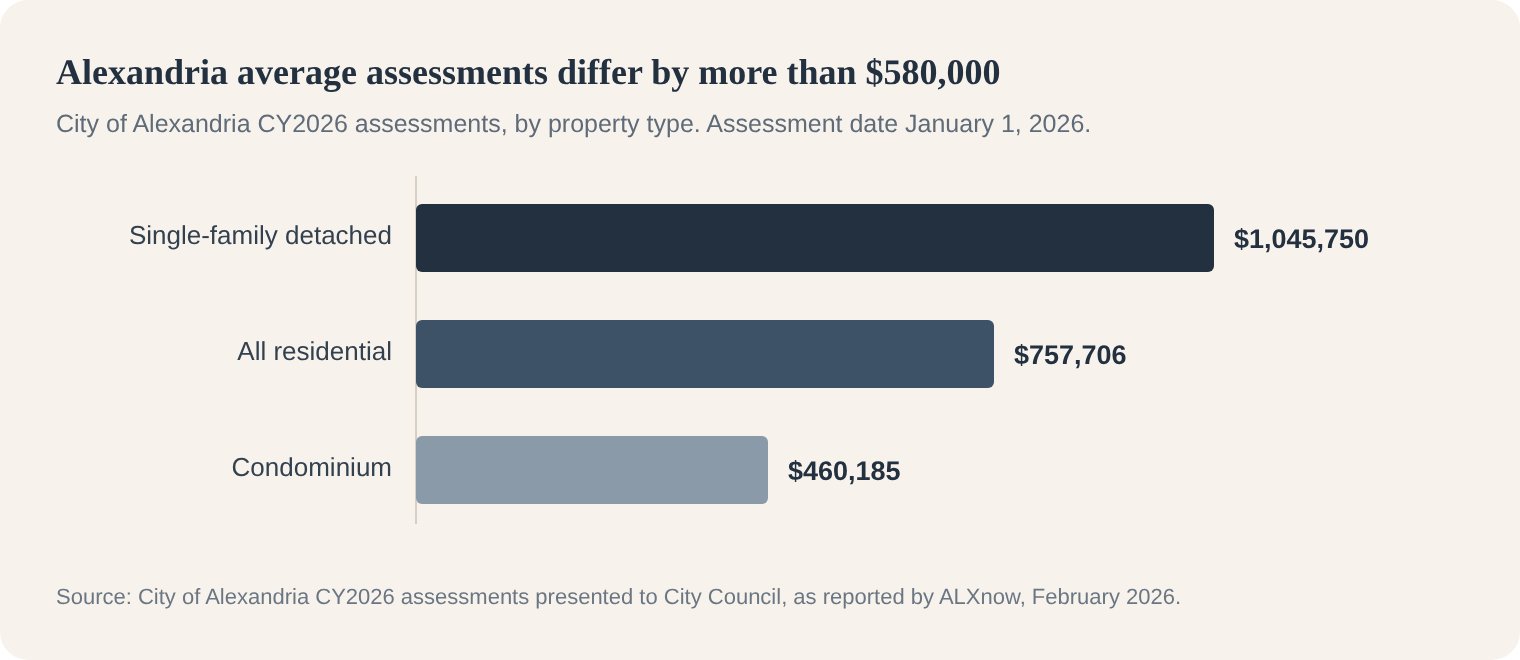
Average assessed values by property type, City of Alexandria, CY2026.
Averages are useful for understanding the tax base. They are close to useless for pricing your particular house, and the figures the City presented to Council show why. Of Alexandria's residential properties, 63% were assessed higher for CY2026, 29% stayed flat, and 8% came in lower (ALXnow).
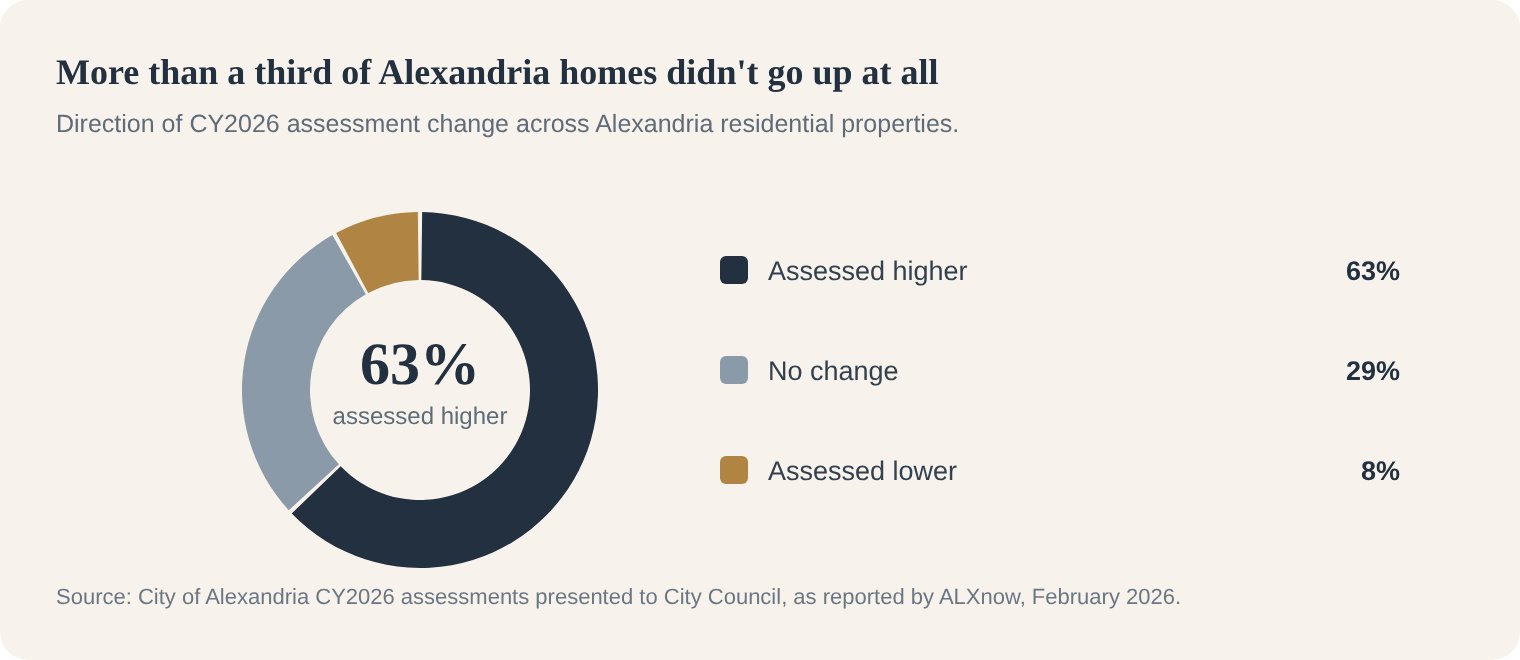
Not every Alexandria property moved the same direction for CY2026.
Here's the part that matters for timing. That assessment is dated January 1, and it's built from sales that closed before it. List in September off a January 1 number and you're pricing against a market that's most of a year behind you. Sometimes that means it's low. On a block that cooled off, it can just as easily be high.
Either way, it isn't a list price. It was never trying to be.
Why the instant estimates struggle here
Automated valuation models are good at a specific job: taking public records and listing data, finding patterns, and producing a fast number at enormous scale. When a home is actively listed, the model has photos, a description, square footage the seller just confirmed, and a price the seller just set. It's grading with the answer sheet partly visible.
When a home isn't listed, all of that disappears. Zillow's published Zestimate accuracy data has consistently shown a materially higher median error rate for off-market homes than for homes actively on the market; the current figures are on Zillow's accuracy page. That's not a knock on the engineering. It's a description of what's missing.
Now apply that to Alexandria.
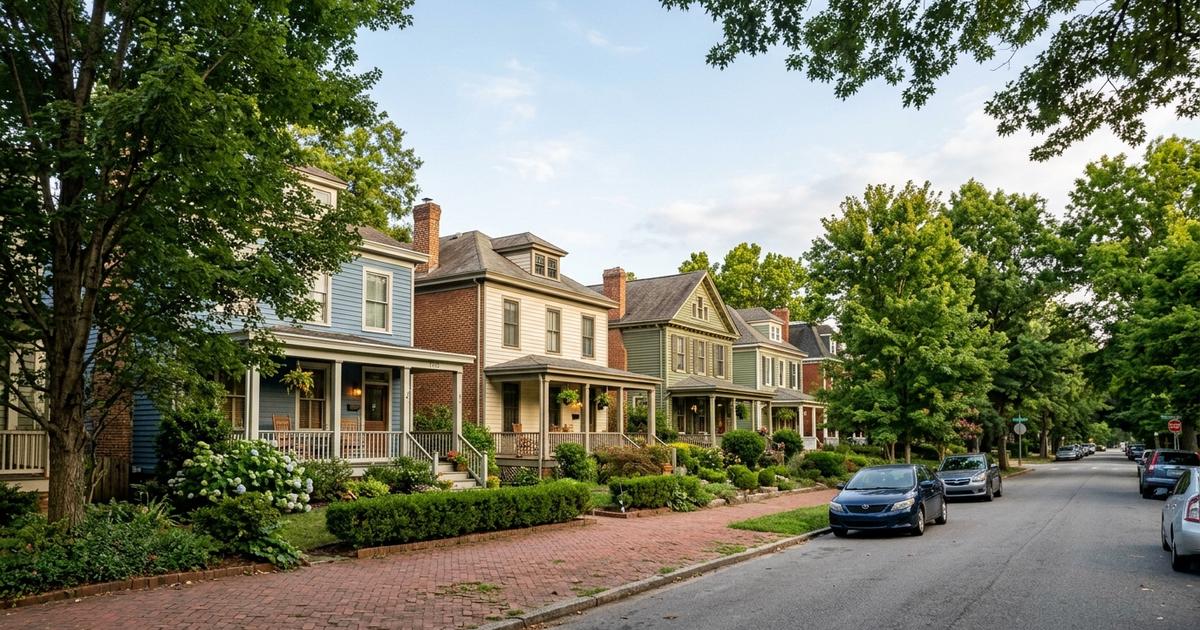
A 1930s Rosemont four-square with an addition off the back. A Federal rowhouse off South Lee with 8-foot ceilings on the top floor and no off-street parking. A Del Ray bungalow where the previous owner finished the basement without a permit. A Warwick Village townhouse that looks identical to forty others from the street and isn't, because this one backs to green space.
A model sees square footage, bedroom count, and a tax record. It has never walked the neighborhoods it's pricing. It does not see the ceiling height, the parking, the light in the back room at four in the afternoon, or the fact that the "comp" it just used sold in a completely different condition. Our housing stock ranges from 19th-century historic to postwar to brand-new construction, sometimes within a few blocks. That variation is precisely where automated models lose the thread.
Use the online estimate as a rough orientation. Just don't let it set your expectations, in either direction.
What actually moves the number on your block
When we sit down with a house, these are the things that change the answer more than anything the internet knows about it:
- Condition, honestly assessed. Not "updated," but what a buyer sees in the first ninety seconds. Kitchens and baths carry the most weight. Roof, windows, and systems set the ceiling.
- Parking. In much of Old Town, off-street parking is a real line item. In Del Ray and Rosemont, a driveway or a rear pad changes the buyer pool.
- Usable space, not just square footage. A finished third floor with headroom is different from a walk-up attic. A dry, permitted basement is different from a damp one.
- Outdoor space. Even a small, private, well-kept patio or yard moves the number more here than most sellers expect.
- The block itself. Corner lots, through streets, proximity to a park or a Metro walk, and which side of a busy road you're on. Two houses six blocks apart in the same Alexandria neighborhood are not comparable.
- Historic district rules. If you're inside one of Alexandria's historic districts, exterior changes go through architectural review. That shapes what a renovation can and can't do, and buyers price that in.
- For condos, the building. The fee, the reserves, the special assessment history, and whether the building is warrantable for financing. This can matter more than anything inside the unit.
- Timing and competition. How many similar homes are on the market the week you list.
That last one is worth a note. In July 2026, homes that closed in the City of Alexandria spent an average of 24 days on the market, about where they were a year earlier. Active listings at the end of the month were up roughly a third year over year, and pending sales were down about 30% (ALXnow, reporting Bright MLS data). More homes sitting available, fewer going under contract. Those are citywide figures, not your street, and they move month to month. NVAR posts a fresh regional report each month (NVAR market statistics). What we've seen on our own listings points the same way. There's more inventory and more patience in this market than there was in 2021, and pricing has to respect that.
What a real CMA actually involves
A comparative market analysis isn't a form. It's a set of judgment calls, and the judgment is the product.
Choosing the comps
We start with what's sold nearby and recently, then throw most of it out. A sale from ten months ago in a different market isn't a comp. A house across a major road isn't a comp. A gut renovation isn't a comp for a home with the original kitchen, no matter how close it sits.
What's left is usually a small number of genuinely similar sales, plus the active and recently expired listings that tell us what your buyers are choosing between right now.
Making the adjustments
Then we account for the differences. An extra half bath. Two hundred more finished square feet. A parking space. A better lot. This is where local knowledge does its work, because the value of a parking space in Old Town is not the value of a parking space in Seminary Ridge, and no national model prices that gap correctly.
Walking the house
We come see it. Photos and tax records don't tell us about the slope of the yard, the smell of the basement, or the two rooms that would show completely differently with the furniture moved.
Talking it through
You get a range, not a single number, plus what we'd expect at each end of it and what it would take to reach the top. If the timing or the number doesn't work for what you're trying to do, that's worth knowing now. We've told plenty of people that this isn't their year.
The whole thing is free, and there's no obligation attached to it. You can request a home valuation whenever you're ready.
Things worth doing before you call anyone
None of these take much, and all of them make the conversation better:
- Pull your assessment notice and check the basics. Square footage, bedroom and bath count, lot size. Assessment records carry errors more often than people expect, and a wrong record can follow you into an appraisal.
- List what you've done to the house. Dates, rough costs, and whether it was permitted. The permitted basement and the unpermitted one are worth different amounts.
- Write down your actual timeline. "We want to be in the next place by June" changes the pricing strategy more than any feature of the house does.
- Note the sale on your street that bothered you. The one that seemed high or low. There's almost always a reason, and it's usually informative.
When a valuation is worth doing even if you're not selling
Plenty of the valuations we run never turn into a listing, and that's fine.
People ask for them when they're deciding whether to renovate or move. When they're refinancing or pulling out equity. When they're weighing an assessment appeal. When they're settling an estate or dividing property, and everyone needs the same honest number to work from. When they're doing the math on whether a smaller place nearby actually frees up what they hoped it would.
And sometimes just because it's been six years and they're curious. That's a fine reason too.
If you'd rather read your way in first, our neighborhood field guides and market notes cover a lot of the same ground block by block.
Questions we get
How is a CMA different from an appraisal?
A CMA is a real estate agent's estimate of what the market will pay, used to set a strategy. An appraisal is a licensed appraiser's formal opinion of value, ordered by a lender after a contract is signed, to confirm the house supports the loan. The CMA comes first and costs nothing. The appraisal comes later and is paid for by the buyer.
Does a home valuation cost anything?
No. We don't charge for a CMA, and asking for one doesn't commit you to listing.
How long does it take?
Usually about a week. A day or two to pull and study the comps, a visit to the house, then a conversation. Faster if you're on a deadline.
Can I just use my assessment to price my home?
We wouldn't. It's dated January 1, built on older sales, and produced for tax purposes rather than for a sale. Use it as one input among several.
Should I renovate before I sell?
Sometimes, and less often than people assume. The projects that tend to pay back here are usually smaller than the ones sellers are considering. That's a specific conversation about your house, your block, and your timeline, and it's worth having before you spend anything.
What if the number is lower than I hoped?
Then you know, and you have options you didn't have yesterday. Wait. Adjust the plan. Do the two things that would move it. The number is information, not a verdict.
When you're ready
We're the LizLuke Team at Long & Foster Real Estate, 110 N Royal Street in Old Town, and we've been pricing homes in Alexandria for more than twenty years. Virginia license #0225069250. We'd be glad to put a real number to yours, whether you're listing next month or just thinking out loud about next year.
It starts with a conversation. Reach out whenever you want to have it, or call the office at (703) 868-5676. You can also read more about the team first.
All information is deemed reliable but not guaranteed. Market data referenced above is dated and sourced as noted; verify current figures before making decisions. Equal Housing Opportunity.