A Del Ray homeowner planning a routine renovation added a wall oven to an existing room. No cooktop, no separate entrance, nothing that looked like a second home. City staff disagreed. Under the single-family zoning ordinance, they ruled, any cooking appliance, even a wall oven without a burner, and even the mere possibility that someone might set a microwave on the counter, meant the space qualified as an accessory dwelling unit. The renovation needed an ADU permit it was never designed to need. The homeowner later said plainly: "our reno work should not have needed an ADU permit." The delay ran months. The cost climbed with it.
That story, reported by Alexandria Living Magazine, is not really about one contractor's bad luck. It is a preview of how granular Alexandria's ADU rules get once you're inside them, and why the headlines about a new statewide ADU law circulating this year matter less in Del Ray than they might in almost any other part of Virginia.
The Headline Law That Skips This Neighborhood
Governor Abigail Spanberger signed Senate Bill 531 on April 13, 2026. Starting July 1, 2027, it requires localities across Virginia to permit accessory dwelling units by right in single-family zones, caps permit fees at $500, and removes the requirement that an ADU occupant be related to the homeowner. It reads like a clean, statewide reset.
It isn't, in Alexandria. The law exempts any locality that already had its own ADU ordinance in place before January 1, 2026. Alexandria adopted its ADU policy on January 23, 2021, five years ahead of that cutoff. So the city keeps running its own program under Zoning Ordinance Section 7-203, unaffected by the new statewide floor. If you've read about SB 531 and assumed it simplifies things everywhere, Del Ray is one of the places where that assumption doesn't hold.
The Number That Actually Decides Your ADU
Alexandria's existing rule sets a detached ADU's maximum footprint as the greater of one third of the main house's floor area, or a flat size tied to the lot itself:
Lot size | Max detached ADU footprint |
|---|---|
2,500 square feet or smaller | 350 square feet |
Larger than 2,500 square feet | 500 square feet |
A detached unit also needs to sit at least one foot back from the rear property line, three feet if any windows face that line, and the city doesn't require additional parking for it. Those setback numbers are modest. The size threshold is the one that changes what you can actually build.
Del Ray Was Platted for This Exact Fight
Del Ray's original plat dates to 1894, filed by the Ohio development firm Wood and Harmon, before the area briefly became its own incorporated Town of Potomac in 1908 and was annexed into Alexandria in 1930. Longtime local agents and neighborhood historians describe those original lots as narrow, commonly around 25 by 100 feet, which works out to almost exactly 2,500 square feet. That is the same figure the modern ADU ordinance uses as its dividing line, more than a century later and for entirely unrelated reasons.
Here is where it gets interesting for a buyer. Plenty of Del Ray's early houses weren't built on a single original lot. Historic building permits from the neighborhood document owners buying and combining two adjoining parcels before construction, creating 50 by 100 foot lots twice the platted size. The practice was common enough that it shows up repeatedly in the city's own historic preservation records.
The result today: two Del Ray houses can sit two doors apart, both from the same decade, both with the same bungalow massing and the same porch, and one can be legally capped at a 350 square foot backyard unit while the other qualifies for 500. Nothing about the listing photos tells you which is which. Nothing about the sale price does either. It's in the recorded lot dimensions, and those live in the deed history, not the marketing copy.
The city's own reasoning for allowing ADUs at all makes the stakes clear. A 2021 staff report noted that renters across Alexandria, including young professionals, graduate students, and retirees, "could all benefit from the additional workforce rental options created by allowing ADUs." That's the policy goal. Whether a specific Del Ray lot can deliver on it depends on a line drawn well before anyone alive today owned the house.
What the Extra 150 Square Feet Actually Buys
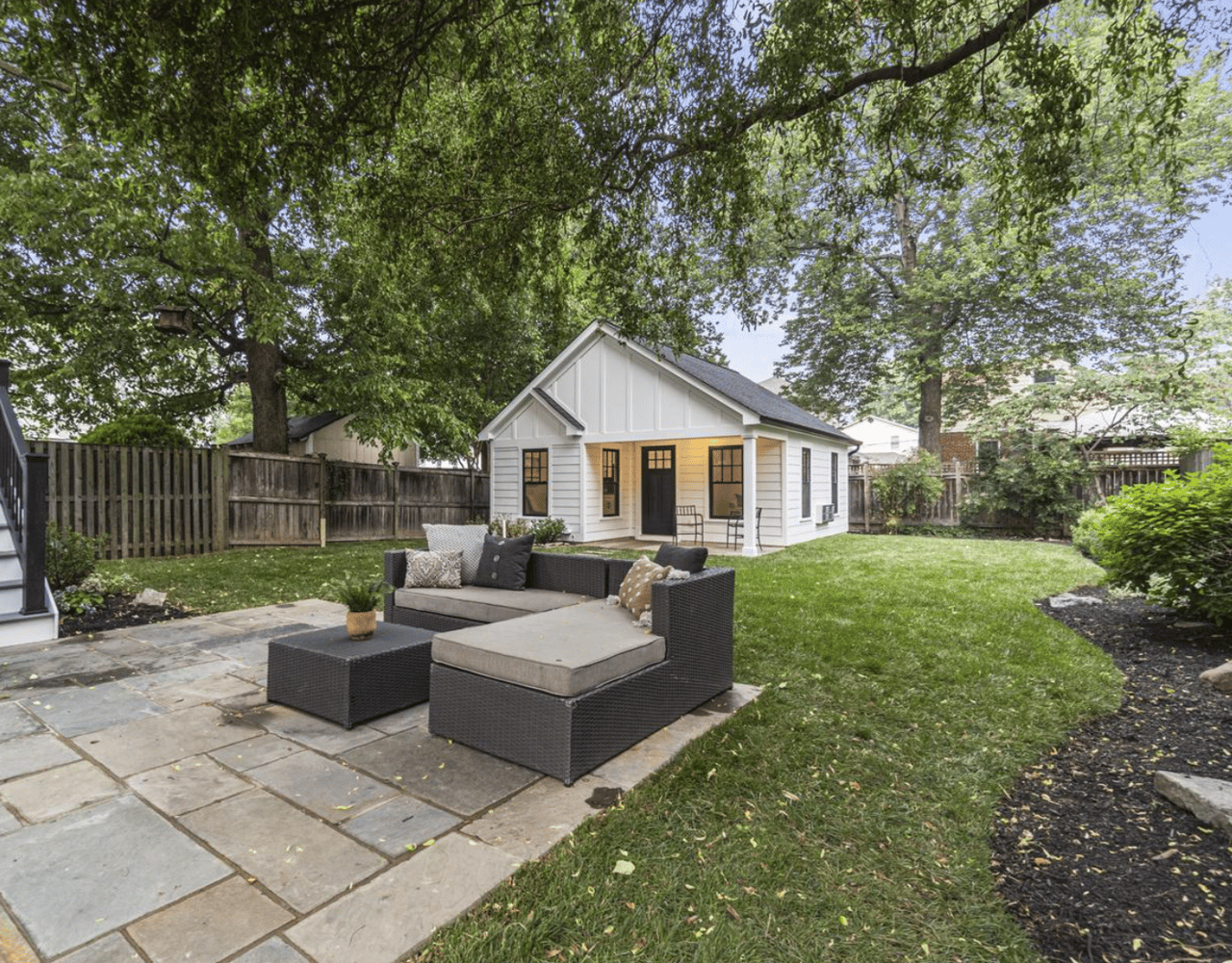
A 350 square foot ADU generally fits a studio layout: a bathroom, a sleeping nook, a small kitchenette. A 500 square foot unit crosses into something closer to a real one bedroom, with a separated living area. One completed Del Ray project by the design firm Four Brothers Design + Build shows what that larger size supports in practice: a full bathroom, its own washer and dryer, a sleeping area convertible to a home office, and a downstairs kitchen and den that opens to a shared courtyard. That layout needs the room a 350 square foot cap won't give you.
The dollars scale with the square footage. Northern Virginia ADU construction typically runs from roughly $75,000 for a basement conversion up past $350,000 for a ground up detached unit, depending on finish level and whether it's attached or freestanding. At that range, 150 extra square feet isn't a rounding error. It's the difference between a unit that rents as a compact studio and one that competes as a genuine one bedroom, which changes both the monthly rent it can command and how a lender treats it when the time comes to refinance or sell.
The Friction Nobody Puts on a Spec Sheet
A 2024 case at 404 East Alexandria Avenue shows how contested this can get even when the numbers pencil out. A proposed two story ADU on a Del Ray alley lot went to the city's Planning Commission, which recommended approval on a divided 4 to 3 vote, then still required a full City Council hearing before construction could move forward. That level of scrutiny for what is supposed to be an administratively reviewed permit tells you the process isn't always as smooth as the ordinance's language implies.
The wall oven case points to the same gap from a different angle. City code includes a provision, Section 2-141, meant to exempt spaces that share HVAC with the main house and aren't separated by walls or doors from being classified as a separate dwelling unit. In that documented case, staff didn't apply it. The homeowner had to bring in a design-build firm experienced specifically with ADU cases just to get a straightforward renovation approved.
The practical takeaway for a buyer: don't rely on a general sense that a property "should" qualify. Before writing an offer with an ADU in the plan, ask whether the property has already gone through any zoning review for additions or garage conversions, and get the lot's classification confirmed by the city rather than assumed from its listed square footage.
Comparing Del Ray to Rosemont or Beverley Hills
Del Ray shares its bungalow and small colonial housing stock with neighboring Rosemont and Beverley Hills, and all three have lots suited to the kind of rear addition or garage conversion that often becomes an ADU. What sets Del Ray apart is the specific overlap between its 1894 platting pattern and Alexandria's modern 2,500 square foot threshold. That overlap is less likely to matter the same way on lots platted differently, which makes it worth asking about specifically if a Del Ray property is on your list because of what an accessory unit could add, not just what the main house looks like.
Del Ray's home prices as of February 2026 ranged roughly from $699,000 to $3.75 million, with a reported median around $825,000. An ADU's rental income matters most at the lower end of that range, where it can meaningfully offset a mortgage payment rather than simply adding a design flourish to a house that was already comfortably affordable without it.
One more limit worth knowing before penciling in rental income: Alexandria still requires the property owner to live in either the main house or the new unit, and the policy is built around long-term housing rather than short-term stays. That owner-occupancy requirement was something the Del Ray Citizens Association pushed for specifically when the ADU ordinance was first drafted, aimed at keeping these units as neighbors rather than turnover guests.
A Few Questions Worth Asking Before You Commit
Does Virginia's new ADU law help me if I'm buying in Del Ray right now? Not directly. Alexandria's own ordinance governs your property, and the state's July 2027 by-right framework applies to localities that didn't already have a pre-2026 ordinance of their own.
How do I find out which size tier my lot falls into? City zoning staff can confirm your parcel's recorded square footage, and a title search during the purchase process will surface whether the lot was ever combined from two original parcels. That history is part of the public record even when it never makes it into a listing description.
Can I plan to rent a Del Ray ADU as a short-term rental? Generally no. The policy is structured around owner-occupancy and longer-term housing, not nightly stays.
If an accessory unit is part of why you're looking at Del Ray, the lot's recorded dimensions deserve the same attention you'd give the roof or the foundation. It's the kind of detail that separates a property that can genuinely support a rental unit or an in-law suite from one that only looks like it can.
The LizLuke Team works Del Ray listings block by block, and that includes pulling the lot history before you fall for a house that can't do what you're hoping it will. If you're comparing properties with an ADU in mind, reach out for a conversation about what a specific lot actually allows, or start with a free home valuation if you're weighing whether your current property could support one.