Updated September 2026
You've walked King Street on a Saturday. You've stood at the top of Prince Street and watched the cobblestones drop toward the river. And somewhere in there you started wondering about the blocks north of it all, up past Pendleton toward the marina and the old power plant, and whether they might give you the same water without the same weekend.
It's a fair question. The honest answer has less to do with atmosphere than with two things you can actually look up: which design rules govern your specific address, and where the city is spending construction money right now.
One thing you won't find below is a price comparison. We don't have citable neighborhood-level sale figures for these two areas, so we're leaving prices out and would rather run address-level comparables with you directly.
The short version
The Old & Historic Alexandria District was established in 1946, and the City of Alexandria describes it as the third oldest historic district in the United States. Inside the city's local historic districts, the Board of Architectural Review has to approve a Permit to Demolish before you remove more than 25 square feet of material from a structure. That's a real line on a renovation budget and a real line on a timeline.
The active work is on the Old Town waterfront, where the city's flood mitigation project has been in design for over a decade. In June 2026, City Council changed the design, dropping a pump station the National Park Service had turned down. Construction on the redesigned project is expected to begin in summer or fall 2027.
Old Town North's change is mostly still on paper. City Council adopted the Old Town North Small Area Plan in 2017, and in June 2026 it approved the first phase of a 19-acre redevelopment on the former Potomac River Generating Station site.
Neither one is quiet the way a brochure means quiet. They're loud at different times.
There is no single Old Town line, and that trips people up
Alexandria was established in 1749 with its streets laid out in a uniform grid, according to the Virginia Department of Historic Resources register listing for the Alexandria Historic District. That grid is why the two areas read as continuous on foot, and why people use one name loosely for all of it.
But there are at least three boundaries in play, and they do different work:
- The Old & Historic Alexandria District. A local zoning overlay, established in 1946. This is the one with authority over what you do to the outside of your house.
- The Parker-Gray District. The city's other local historic district, a 40-block area with its own Board of Architectural Review process.
- The Alexandria Historic District on the National Register. A separate boundary drawn for a separate purpose, and not the same line as the local overlay. Rosemont is the clearest example of the difference: it sits on the National Register and it is not under Board of Architectural Review.
Before you fall in love with a house, confirm which of these your specific address sits inside. The City of Alexandria publishes a historic preservation page and map viewer for this. We don't guess at that line for our clients, and it isn't worth guessing at on your own.
Old Town and Old Town North, side by side
What you're comparing | Old Town | Old Town North |
|---|---|---|
Exterior design review | Inside the Old & Historic Alexandria District, the Board of Architectural Review approves a Permit to Demolish above 25 square feet of material, plus Certificates of Appropriateness for new construction and exterior alterations visible from a public way | Depends entirely on whether the address falls inside a local historic district. Confirm it on the city's zoning map before you budget any exterior work |
Governing city plan | The waterfront small area planning framework, which produced the flood mitigation project now in design | The Old Town North Small Area Plan, adopted by City Council in 2017 after a process guided by a 21-member Advisory Group |
Largest project on the table | Waterfront flood mitigation, designed to improve riverine flood protection up to elevation +6.0 feet NAVD88 | The former Potomac River Generating Station site, 19 acres, first phase approved June 2026 |
Money attached to it | Roughly $141 million still available against a redesigned project estimated at $145 million to $165 million, as reported in July 2026 | $135 million in bonds split over two phases under a 30-year tax increment financing district |
What developers contribute | Not set by a single small area plan figure | $9 per square foot in 2018 dollars for redevelopment sites one through ten |
Planned public open space | Delivered through the waterfront project itself | More than 10 acres of publicly accessible open space at full buildout, including waterfront access |
Timing of the disruption | Utility work underway now, main construction expected summer or fall 2027 | Approved, not yet built |
What design review actually costs you in Old Town
This is the difference buyers underestimate, and it has nothing to do with how a street feels.
Inside Alexandria's local historic districts, the Board of Architectural Review must approve a Permit to Demolish for any proposed demolition of more than 25 square feet of material on a structure, per the City of Alexandria's historic preservation guidance. Twenty-five square feet is not a wing of the house. It's a section of siding. It's a chimney. It's the back wall you were planning to open up for the kitchen.
The Board also reviews Certificates of Appropriateness for new construction and for exterior alterations visible from a public way. Note which test governs which. Visibility decides whether an alteration needs review. It does not decide whether a demolition does. Windows. Roofing. Fencing. Paint on masonry that was never painted.
The Parker-Gray District, the city's other local district, covers a 40-block area and runs its own review. None of this is a reason to walk away from a house. All of it is a reason to build board calendars into your renovation schedule before you make an offer, and to ask a contractor who has actually sat through an Alexandria BAR hearing what the timeline really looks like. We walked through the rest of that homework in the due diligence most buyers miss on a historic home in Old Town.
What to do with this: pull the district status on the address, then price the exterior work you have in mind with review time included, not as an afterthought.
The Old Town waterfront is an active construction program
This is the part that most directly earns the word "quieter," and it's a timing fact rather than a character judgment.
The City of Alexandria's own waterfront flood mitigation project history records City Council approving a 15% Schematic Landscape Design in June 2014. The design target is improvement of riverine flood protection up to elevation +6.0 feet NAVD88. The city priced the Schematic Landscape design alternative at approximately $200 million in 2021 dollars.
The plan changed this year. After the National Park Service turned down a pump station at Waterfront Park, City Council in June 2026 advanced a different approach: an enhanced gravity storm sewer system that drops the pump station altogether. Alexandria Brief, reporting in July 2026 on the redesigned project, puts the authorized option at between $145 million and $165 million, against approximately $141 million in remaining available funding.
Measure | Amount |
|---|---|
Funding still available | $141 million |
Estimated cost, low end | $145 million |
Estimated cost, high end | $165 million |
The schedule matters more than the price if you are buying near the water. The grading plan and 70% design are due this fall. A guaranteed maximum price proposal from Skanska and JMT follows in fall or winter 2026. Final design runs winter 2026 into spring 2027, and construction is expected to begin in summer or fall 2027. Utility investigation work started in the streets in July 2026.
The reason the city keeps spending on it is measurable. Alexandria Brief reports 227 sunny-day flooding events at Prince Street level in the past year against a 20-year average of 145, and river overtopping events running 93 per year against a 20-year average of 37.
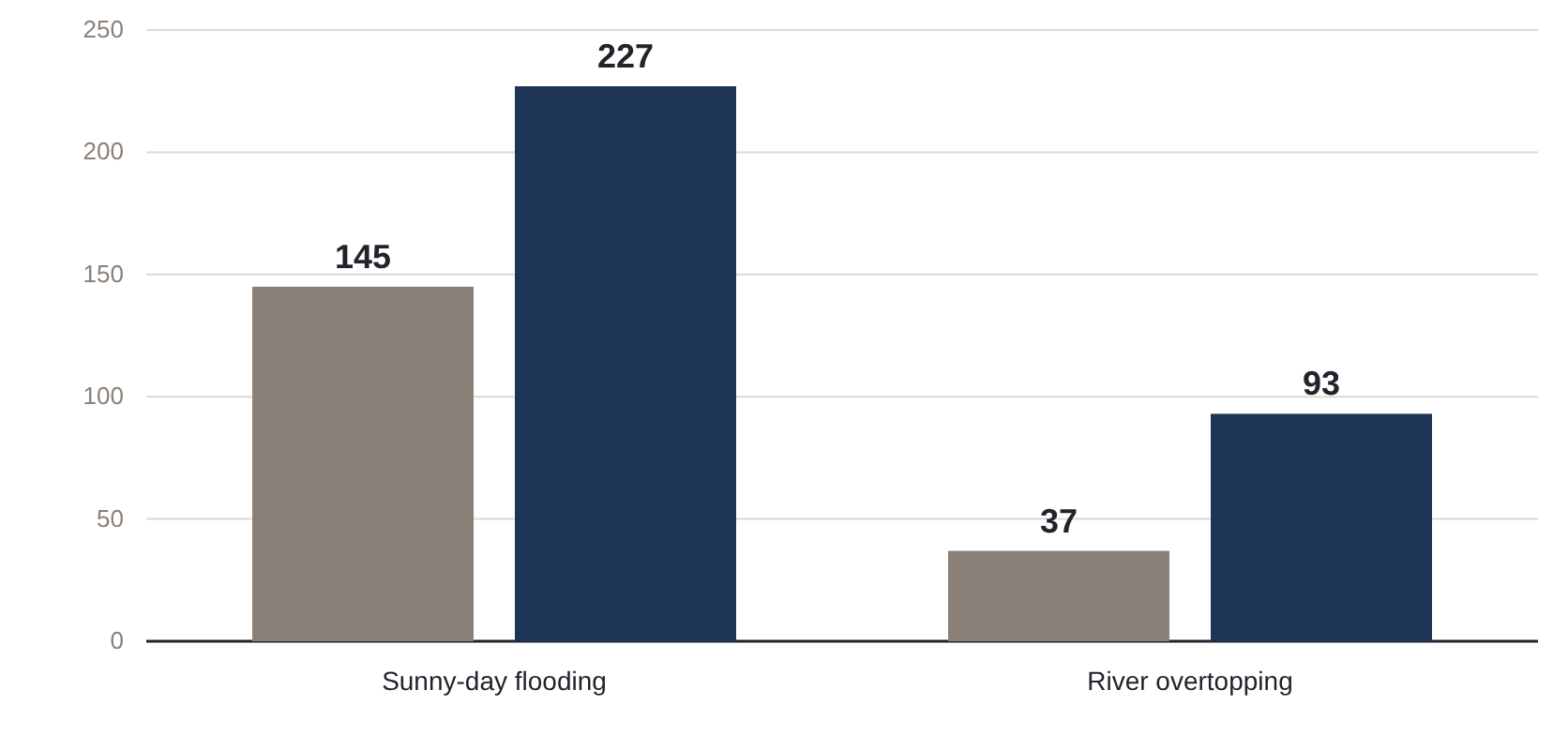
Event type | Past year | 20-year average |
|---|---|---|
Sunny-day flooding | 227 | 145 |
River overtopping | 93 | 37 |
Two boundary notes on those figures, because they matter. They describe the Alexandria waterfront as a whole. Neither source splits them between Old Town and Old Town North, and we're not going to split them for you. And the funding picture is city-wide too: the City of Alexandria's stormwater management funding page reports $6.41 million in Community Flood Preparedness Fund grants received across six projects, of which the waterfront award is $3,241,200 in grant funds.
What to do with this: if you're looking within a few blocks of the water in Old Town, ask where your block sits in the project's phasing, order the elevation certificate early, and get a flood insurance quote before you're under contract rather than after. This is general information and is not legal or tax advice.
Old Town North is approved change, not current change
Old Town North has a plan, and the plan is specific.
City Council adopted the Old Town North Small Area Plan in 2017, following a process guided by a 21-member Advisory Group. The plan set a developer contribution of $9 per square foot in 2018 dollars for redevelopment sites one through ten. The city also designated an arts and cultural district in the plan area.
Then there's the power plant.
Alexandria Living Magazine reported that City Council unanimously approved the first phase of the redevelopment of the 19-acre former coal-fired Potomac River Generating Station site in June 2026. At full buildout the site is planned for up to 2.5 million square feet of residential and commercial buildings, approximately 160 affordable housing units, and more than 10 acres of publicly accessible open space including waterfront access. The financing runs $135 million in bonds split over two phases across a 30-year tax increment financing district, projected to generate approximately $770 million in net new revenue for the City of Alexandria, with a projected 3,100 permanent and construction jobs.
Approval is not a shovel. What Council cleared in June 2026 was a first phase, and those buildout figures describe the site at full buildout, not next spring.
What to do with this: if you're buying in Old Town North, look at what's entitled around you, not just what's standing. A view is only as permanent as the zoning behind it.
So which side is actually quieter?
It depends on what you mean, and the sourced answer splits three ways.
If quieter means fewer approvals between you and a new set of windows, that's a question about your address rather than your neighborhood. The city's zoning map settles it, and it settles it block by block.
If quieter means less active construction near your front door over the next several years, the work with funding, a design percentage, and a cost estimate attached to it is the waterfront flood mitigation project on the Old Town waterfront.
If quieter means how the view will look in ten years, Old Town North is the area carrying up to 2.5 million square feet of approved change on a 19-acre site. Different clock, same city.
What we won't tell you is that one is calmer, safer, or a better bet than the other. We don't have data that says any of that, and where we do have data, it points at timing and paperwork.
Questions worth asking before you write an offer
- Which districts is this address actually in? Local overlay, National Register boundary, or neither. Get it from the city's map, not from a listing description.
- What does the elevation certificate say? Order it early. It changes your insurance conversation and sometimes your lender conversation.
- Where does this block sit in the waterfront project's phasing? "Near the water" covers a lot of ground and a lot of construction sequencing.
- What's entitled next door and across the street? Especially in Old Town North, where a lot is approved and not yet built.
- What will the exterior work I want actually take? Not the construction time. The approval time.
Common questions
Is Old Town North part of Old Town?
Colloquially people fold them together, and the street grid encourages it. Officially they're governed by different documents. Old Town North has its own small area plan, adopted by City Council in 2017. The Old & Historic Alexandria District is a separate local zoning overlay with its own boundary, and the National Register district is a third boundary again.
Does the Board of Architectural Review apply in Old Town North?
It applies inside Alexandria's local historic districts. The city maps those boundaries, and the only reliable answer is the one you get from that map for your specific parcel. Don't take a general answer for a specific address.
Will the waterfront construction ever be finished?
It's a long program, not a single build. City Council approved the 15% Schematic Landscape Design in June 2014, and the design changed again in June 2026, when Council dropped the pump station and advanced a gravity storm sewer system instead. As reported in July 2026, that option is estimated at $145 million to $165 million against roughly $141 million still available, with construction expected to begin in summer or fall 2027. Plan around it as ongoing.
Is anything being built at the old power plant site right now?
City Council approved the first phase in June 2026. The 19-acre site is planned for up to 2.5 million square feet at full buildout, which is a long horizon rather than an immediate one.
Which one is the better investment?
We don't project appreciation or resale value, for either area or any other. What we can do is show you what's approved, what's under review, and where the city has committed money, and let you weigh that against how long you plan to stay.
Let's talk about your actual block
The useful version of this conversation isn't about two neighborhoods. It's about one address, the district it sits in, and what the city has approved within a few blocks of the front door. That part we can pull for you.
Elizabeth Lucchesi and The LizLuke Team at LONG & FOSTER REAL ESTATE INC have been working these blocks for years, and most of our business comes from referrals and repeat clients. If you're weighing Old Town against Old Town North, or you already have an address in mind and want to know what you'd be signing up for, reach out. It starts with a conversation.
Sources and disclosures
- City of Alexandria, Historic Preservation: Old & Historic Alexandria and Parker-Gray Districts, retrieved September 2026. Carries the 1946 establishment date, the 25 square foot Permit to Demolish threshold, and the 40-block Parker-Gray District.
- City of Alexandria, Waterfront Flood Mitigation Project History, retrieved September 2026. Carries the 15% Schematic Landscape Design approved June 2014, the +6.0 feet NAVD88 design elevation, and approximately $200 million in 2021 dollars.
- City of Alexandria, Old Town North Small Area Plan, retrieved September 2026. Carries the 2017 adoption, the 21-member Advisory Group, and the $9 per square foot developer contribution in 2018 dollars for redevelopment sites one through ten.
- City of Alexandria, Stormwater Management Funding, retrieved September 2026. Carries $6.41 million in Community Flood Preparedness Fund grants across six projects and the $3,241,200 waterfront grant award.
- Virginia Department of Historic Resources, Alexandria Historic District register listing, retrieved September 2026. Carries the 1749 establishment of Alexandria.
- Alexandria Brief, coverage of City Council's review of the waterfront flood plan (March 2026), retrieved September 2026. Carries the flooding-event counts measured at Prince Street level, the $142 million in city capital funds approved May 2025, and the $3.24 million state grant. Local press reporting on city action, not a primary city document.
- Alexandria Brief, coverage of the redesigned waterfront flood project and the utility investigation work beginning July 13 (July 2026), retrieved September 2026. Carries the $145 million to $165 million estimate for the authorized option, the approximately $141 million in remaining available funding, and the design and construction schedule. Local press reporting on city action, not a primary city document.
- ALXnow, coverage of City Council advancing an alternate waterfront flood mitigation system after the National Park Service pump station denial (June 2026), retrieved September 2026. Carries the elimination of the pump station and the 30-year term of the $135 million tax increment financing agreement. Local press reporting on city action, not a primary city document.
- Alexandria Living Magazine, coverage of City Council's unanimous approval of the first phase of the Old Town North power plant redevelopment, retrieved September 2026. Carries the June 2026 unanimous approval, the 19-acre site, the 2.5 million square feet at full buildout, the approximately 160 affordable housing units, the more than 10 acres of publicly accessible open space, the $135 million in bonds split over two phases, the approximately $770 million in net new revenue, and the 3,100 projected jobs. Local press reporting on city action, not a primary city document.
Flooding-event and grant figures above describe the Alexandria waterfront and the City of Alexandria as a whole. They are not broken out between Old Town and Old Town North, and nothing here should be read as a block-level flood risk statement for any specific address. Historic district boundaries must be confirmed per address against the city's own map. This is general information and is not legal or tax advice.
The LizLuke Team at LONG & FOSTER REAL ESTATE INC. 110 N Royal St, Ste 300, Alexandria, VA 22314. Office 703.683.0400. The LizLuke Team (703) 868-5676. Virginia License #0225069250.
Equal Housing Opportunity.
All information is deemed reliable but not guaranteed.