

Updated October 2026
You found the condo. The light is right, the walk to the coffee shop is right, and the monthly fee looks reasonable. Then someone hands you a resale packet as thick as a phone book, and the question changes from do I love it? to what exactly am I signing up for?
That's the right question. Here's the short answer.
A condo fee is your share of the building's common expenses, split the way the building's recorded documents say. The resale packet is what Virginia law calls a resale certificate. The association has 14 days to deliver it after the seller asks in writing. Unless your contract sets a different window, delivery before contract ratification gives you three days from ratification to cancel; delivery after ratification gives you three days from receipt. Cancellation requires written notice to the seller under the contract's terms.
Everything else is detail. But the detail is where the money is.
First, which Alexandria is it?
An Alexandria mailing address doesn't tell you who sends the tax bill. The City of Alexandria is an independent city. Plenty of homes with an Alexandria address sit in Fairfax County, including the 22307 ZIP code, which includes Belle Haven and New Alexandria.
That matters for a condo buyer in two ways. The county or the city sets your real estate tax rate, and the land records that hold the building's recorded documents live with that jurisdiction's circuit court. Check the parcel record before you compare anything.
It also matters whether the property is legally a condominium at all. Under the Virginia Condominium Act, a building becomes a condominium through recorded condominium instruments, not through the word "condo" on a listing. A townhome community with an HOA is a different animal with different documents.
What condo fees actually pay for
The Condominium Act gives every building the same basic framework and then lets the building's own documents fill in the rest.
The framework is this. Common expenses that aren't specially assessed get divided among the units in proportion to each unit's votes in the association, or by each unit's undivided interest, depending on what the condominium instruments say, under the Act's rules on liability for common expenses. Same section, one detail buyers miss: unless the instruments say otherwise, the cost of maintaining, repairing, or replacing a limited common element "shall be specially assessed against the condominium unit to which that limited common element was assigned."
In plain terms, a limited common element is a piece of the shared property reserved for one or a few units. Think of an assigned balcony, patio, or parking space. If the building's documents follow the default rule, your balcony repair can land on your bill alone.
The same section's default rule, except to the extent the condominium instruments or the association's rules or regulations provide otherwise, lets the executive board charge a late fee on any assessment or installment not paid within 60 days of the due date. That fee may not exceed the penalty provided for in § 58.1-3915.
What the statute doesn't do is tell you what your particular fee covers. Water, heat, a front desk, a pool, a garage space, trash: that list comes from the declaration, the current budget, and the resale certificate for that unit. Two buildings a block apart can bundle very different things into one monthly number. Our Old Town Alexandria condo guide walks through how that plays out building to building.
One more line to hold onto. The condo fee is not your property tax. Taxes are billed to you separately, on your own unit's assessment.
What the resale packet is
"Resale packet" is the everyday name. The Virginia Resale Disclosure Act calls it a resale certificate, and it's prepared by the association (or its managing agent) after a written request by a seller or seller's agent. The seller asks. The association prepares. The buyer receives.
What's inside
Under the Resale Disclosure Act, the certificate has to include, among other items:
- The amount and payment schedule of assessments, plus any unpaid assessments currently due
- Any other fees an owner of the unit has to pay
- The amount and payment schedule of any approved additional or special assessment
- The amount of reserves for capital expenditures
- The current operating budget
- The current reserve study, or a summary of it
- Any unsatisfied judgments against the association and the status of pending lawsuits
- The association's insurance coverage
- Any restriction, limitation, or prohibition on renting the unit
If you only read three pages, read the special assessments, the reserve study, and the litigation disclosure. In my experience, those are the pages that change minds.
The clock: 14 days, three days, and settlement
Here's the timeline the law sets.
The association has 14 days after the seller's written request to deliver the certificate. If it isn't delivered in that window, the Act says it "shall be deemed unavailable."
Under the Act's cancellation rule, if the certificate or notice that it's unavailable is delivered to you or your agent before contract ratification, the default cancellation period is three days from ratification. If delivery occurs after ratification, the default is three days from receipt. Your contract can set its own period, so read that clause before you sign. And if neither the certificate nor a notice of unavailability has been delivered, you "may cancel the contract at any time prior to settlement." You must provide written notice of cancellation to the seller in accordance with the contract's terms, and you bear the burden of demonstrating delivery of that notice.
For sellers, my read is simple: request the certificate early. A late packet can complicate closing plans and may leave the buyer with a cancellation right, depending on the contract's period and whether a notice of unavailability has already been delivered. We build that request into the same prep calendar as paint and photos, the way our thirty-day punch list for Alexandria sellers lays it out.
Who pays for the packet (it isn't your monthly fee)
The resale certificate costs money, and that charge is separate from the monthly assessment.
Under the Act's resale certificate fee rules, "the seller shall be responsible for all fees associated with the preparation and delivery of the resale certificate, including any fees for inspection of the unit." If someone asks for an updated certificate before settlement, the requesting party pays for that update. An association can also charge a post-closing fee.
The Common Interest Community Board sets the maximum the association can charge for each of these. The current maximums took effect January 12, 2023, and the law requires them to be adjusted no less than every five years. Each association has to publish its own fee schedule, so ask for it.
Keep three kinds of charges in separate columns when you read the paperwork:
- Recurring assessments. The monthly or quarterly condo fee.
- Special or additional assessments. One-time or installment charges the association approves for a specific cost.
- Transaction charges. Resale certificate preparation, inspection, updates, and post-closing fees.
Who pays what at closing also depends on the contract. Your settlement agent and your agent should reconcile those lines before the closing table, not at it. If you're on the selling side, our guide to selling a home in Alexandria covers where these costs sit in the bigger picture.
Reading the money pages: budget, reserves, special assessments
A low fee is not automatically a good deal. A high fee is not automatically a well-run building. The documents tell you which one you're looking at.
Virginia's Condominium Act budget and reserve rules, except to the extent otherwise provided in the condominium instruments, require the executive board to "conduct a study at least once every five years to determine the necessity and amount of reserves required" and to review the results at least annually to see whether reserves are sufficient. Subject to the same qualification, before each fiscal year begins, the board has to make the annual budget, or a summary of it, available to owners.
So when the packet arrives, we'd start with these pages:
- The reserve study. How old is it? What big-ticket items does it say are coming, and when?
- The reserve balance. Compare it with what the study says the building needs.
- Approved special assessments. These are already decided. Check the installment dates and how the contract allocates payment between seller and buyer.
- The operating budget. Look for line items that tell you what the fee really covers.
- Unpaid assessments and pending lawsuits. Either one can tell you a lot about how a building is running.
That's my framework, not a scorecard the law provides. A building can have a modest fee and healthy reserves. Another can have a steep fee and a roof replacement nobody has funded. You only know by reading.
Insurance: the master policy and your own unit policy
Condo insurance comes in two layers, and the gap between them is where surprises live.
The Condominium Act's insurance provisions allow the condominium instruments to require a master casualty policy "in an amount consonant with the full replacement value of the structures," along with master liability coverage. The Act also sets the association's fidelity coverage, which protects against employee dishonesty, at the lesser of $1 million or the reserve balances plus one-fourth of the aggregate annual assessment. The minimum is $10,000. When the association buys, changes, or drops a policy, owners have to be promptly notified in writing.
Your own policy is the second layer. According to the Virginia Bureau of Insurance's consumer guide to homeowners insurance, "the association policy should cover the basic structure and common property as well as liability for injuries on common property," while a condominium unit owners policy covers a unit owner's personal property "and may include any additions or alterations not insured by the condominium association." The guide also suggests discussing "the benefits of purchasing additional coverage for loss assessments."
Bring the master policy summary from the resale certificate to your insurance agent before you're past your cancellation window. Ask what the master deductible is, what your own unit policy needs to pick up, and whether loss assessment coverage makes sense for that building.
Rules that can change your plans
The certificate is also where you learn whether the condo fits your life, not just your budget.
Rental restrictions are a required disclosure. If there's any chance you'll rent the unit later, for a military move or a job change, that page matters as much as the fee. The certificate also has to disclose pending lawsuits and unsatisfied judgments against the association.
Pet, parking, and renovation rules live in the building's own documents and rules. Ask for them by name if they aren't in the packet you received.
Comparing two condos: the full monthly picture
When two condos carry different fees, compare everything you'll actually pay, not just the fee.
For each unit, line up:
- The monthly assessment, and exactly what it includes
- Any limited common element charges billed to that unit alone
- Approved special assessments and their payment schedule
- Real estate tax on that unit's assessment
- Your unit owners insurance premium
- Utilities the fee doesn't cover
For a unit in the 22307 ZIP code, the tax piece comes from Fairfax County. The county's Board of Supervisors lowered the real estate tax rate from $1.1225 to $1.12 per $100 of assessed value, effective July 1, 2026. Fairfax County's Department of Tax Administration bills it in two installments, due July 28 and December 5, and reported an average residential increase of 3.99% in 2026 assessments. That's a countywide average across residential property, not a condo figure. A unit inside the City of Alexandria is taxed at the city's rate on the city's assessment, so pull that parcel record instead.
If taxes or insurance run through your mortgage escrow, a change on either side shows up in your payment. We explained how that works in why did my mortgage payment go up. For anything about your own tax situation, talk to a CPA.
What recent 22307 sales say about timing
The resale certificate clock matters more when homes sell quickly.
Our analysis of Bright MLS closed-sale data for the 22307 ZIP code, which includes Belle Haven, counts 10 closed residential sales in August 2026, compared with 17 in August 2025. Median days on market was 17 days in August 2026, down from 27 days a year earlier. These figures cover all residential property types, not condos alone, and one month in one ZIP code rests on a small number of sales.
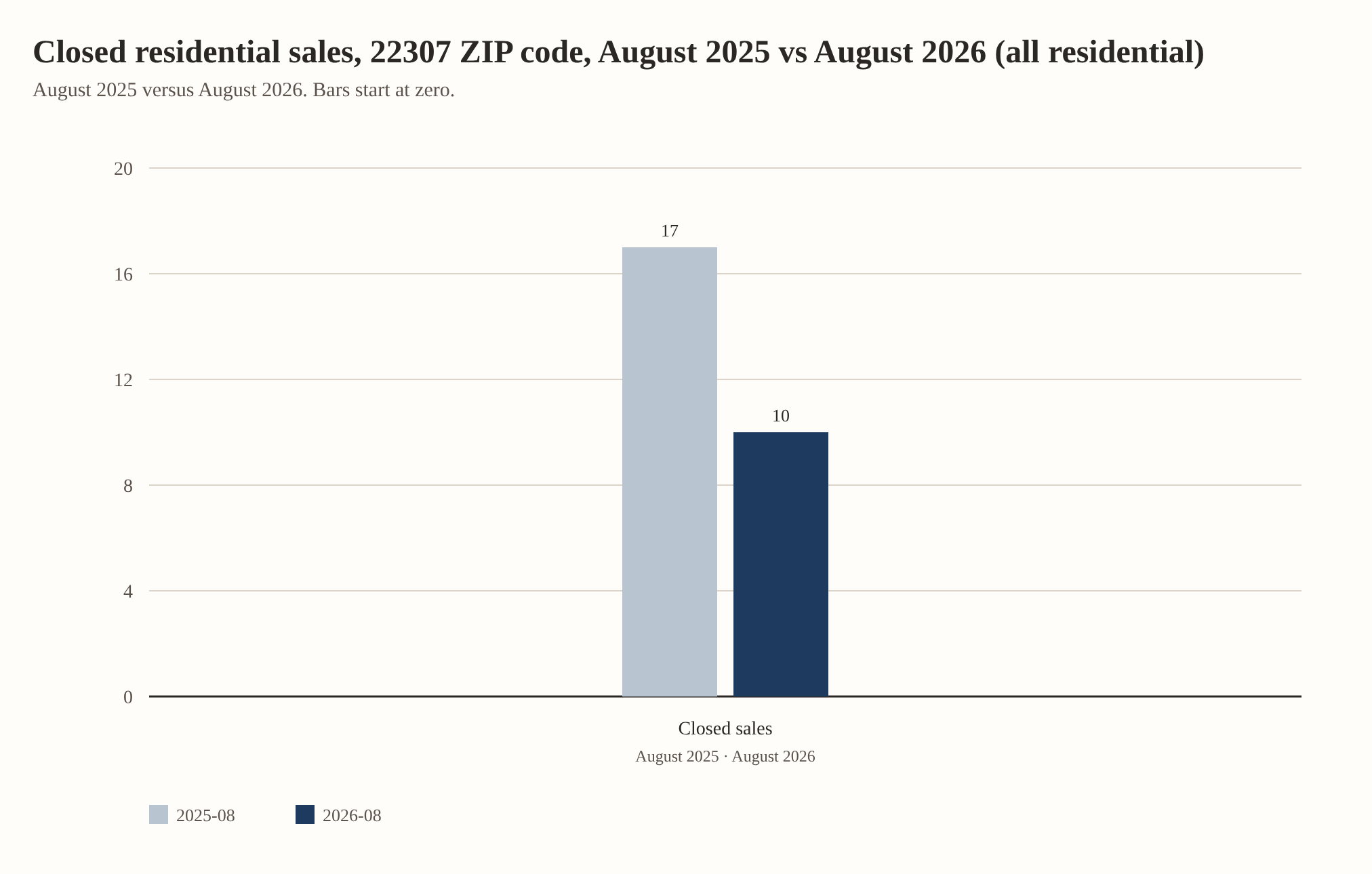
Chart 1. Closed residential sales, 22307 ZIP code, August 2025 vs August 2026 (all residential). Source: Bright MLS closed-sale data, ZIP 22307 (Fairfax County), August 2025 and August 2026, pulled September 27, 2026.
Here's why a seller should care. When the typical home in the ZIP code is selling in a matter of weeks and the association has up to 14 days to produce the certificate, a request made after the contract is signed can eat most of that time. My read: put the request in before you list. For the wider monthly picture, see our August 2026 market pulse.
Law quoted here is the Code of Virginia as published in October 2026. Before relying on any section for a specific contract, confirm it's the version in effect on your contract date.
Elizabeth Lucchesi and The LizLuke Team at LONG & FOSTER REAL ESTATE INC read resale packets with clients before the cancellation window closes, not after. We work the whole market, small condos through the high end. If you're holding a packet and want a second set of eyes, meet the team and reach out. It all starts with a conversation.
This is general information and is not legal or tax advice.
The LizLuke Team at LONG & FOSTER REAL ESTATE INC. 110 N Royal St, Ste 300, Alexandria, VA 22314. Office 703.683.0400. The LizLuke Team (703) 868-5676. Virginia License #0225069250.
Equal Housing Opportunity.
All information is deemed reliable but not guaranteed.
Sources
- Code of Virginia, Virginia Resale Disclosure Act, "Resale certificate; delivery." Virginia Legislative Information System, as published October 2026. https://law.lis.virginia.gov/vacode/title55.1/chapter23.1/section55.1-2309/
- Code of Virginia, Virginia Resale Disclosure Act, "Cancellation of contract by purchaser." https://law.lis.virginia.gov/vacode/title55.1/chapter23.1/section55.1-2312/
- Code of Virginia, Virginia Resale Disclosure Act, resale certificate fees. https://law.lis.virginia.gov/vacode/title55.1/chapter23.1/section55.1-2316/
- Code of Virginia, Virginia Condominium Act, "Insurance." https://law.lis.virginia.gov/vacode/title55.1/chapter19/section55.1-1963/
- Code of Virginia, Virginia Condominium Act, "Liability for common expenses; late fees; additional assessment; authority to borrow." https://law.lis.virginia.gov/vacode/title55.1/chapter19/section55.1-1964/
- Code of Virginia, Virginia Condominium Act, "Annual budget; reserve study; reserves for capital components." https://law.lis.virginia.gov/vacode/title55.1/chapter19/section55.1-1965/
- Virginia State Corporation Commission, Bureau of Insurance, Virginia Consumer's Guide for Homeowners Insurance. https://www.scc.virginia.gov/consumers/insurance/property-casualty-consumer/virginia-homeowners-insurance-guide/
- Fairfax County Department of Management and Budget, "Board of Supervisors Adopts FY 27 Budget, Reduces Real Estate Tax Rate" (May 5, 2026). https://www.fairfaxcounty.gov/budget/board-supervisors-adopts-fy-27-budget-reduces-real-estate-tax-rate
- Fairfax County Department of Tax Administration, Real Estate Assessments & Taxes. https://www.fairfaxcounty.gov/taxes/real-estate
- Bright MLS closed-sale data, ZIP 22307 (Fairfax County), August 2025 and August 2026, pulled September 27, 2026