Everyone in the neighborhood knows the spring version. Cars parked bumper to bumper on Beverley Drive in early May, tripod straps criss-crossing the sidewalk, birders comparing notes about the Cape May warbler someone saw before breakfast. That crowd goes home around Memorial Day and the ridge gets quiet again.
Then, quietly, it starts over. Fall songbird migration at Monticello Park begins in mid-August and runs into late October, and it is almost entirely the property of people who already live here. The spring show belongs to visitors. The fall show belongs to residents, because it rewards the one thing a visitor cannot bring: repeat visits at odd hours, over ten weeks, on a ridge you happen to live on top of.
What "mid-August through late October" actually means on the ground
Fall migration is the same cast, moving the other direction, in duller plumage and without the singing. Thirty-six eastern warbler species have been recorded at Monticello over the years, often in impressive numbers, and in fall birds return in mid-August and continue passing through into late October. That window opens the same week National Night Out lands on the block, and it stays open through the last leaves on the dogwoods.
The catch is that most of the same species pass through during the fall, but they are more difficult to see. Males aren't in breeding color. Nobody is singing. Foliage is still heavy in August and only starts thinning in October, which is exactly when the last migrants push through. The upside for a Beverley Hills homeowner is that this is the one birding spot in Northern Virginia where you don't need to drive at 5 a.m. to catch the good hour. You can walk down, look for twenty minutes, walk back for coffee, and come back after lunch.
Why this particular six and a quarter acres
Monticello Park is smaller than most people's mental image of a birding destination. It sits at 320 Beverley Drive, covers 6.25 acres, is owned by the City of Alexandria, and stays open from 6 a.m. to 9 p.m. year round. Three physical facts do most of the work:
- The park is on a tree-covered ridge, and migrating birds see this small green oasis in the middle of suburbia as a place to land and feed.
- A stream runs the entire length of the park, about an eighth of a mile, and many birds who usually stay high in the trees come down to drink and bathe, allowing close views. Paths run along each side of the stream.
- The perimeter is neighborhood, not more forest. Once a bird drops in, it has nowhere else to go until it moves on, which concentrates the sightings in the exact quarter-mile loop residents already walk their dogs on.
One hundred sixty-five species have been reported at this site to date on eBird, a number that includes nearly every eastern warbler that migrates through the Mid-Atlantic. That is a remarkable density for a park you can walk end to end in five minutes.
A resident's week, mapped
The best way to read fall migration on the ridge is not to make one dedicated trip. It is to add fifteen minutes to walks you were already going to take. Here is what a typical week looks like from mid-August through the first frost:
| Day | Where | What to notice |
|---|---|---|
| Weekday morning | East slope of Monticello, along the stream | Thrushes coming down to bathe; watch the low branches, not the canopy |
| Weekday evening | Beverley Drive side, before sunset | Migration is a night event; birds drop in at dusk to feed and stage |
| Saturday mid-morning | Full loop, both sides of the stream | Highest chance of a mixed feeding flock; slowest, most patient walk of the week |
| Sunday | The Pit, then the ridge | Kids at Beverley Park first, then a quiet lap through Monticello |
| Any warm afternoon | Stream banks | In late morning, when temperatures warm up, birds typically come down from the trees to bathe in the park's stream |
Two utilitarian notes for anyone using the park more than once a week this fall. Admission is free, parking is on surrounding streets, and there are no restrooms or portable toilets. The only amenities inside are a picnic table, a bench, and a small dog exercise area where neighborhood people bring their pets. Plan accordingly.
The homework someone else already did
The single most useful resource for a resident who wants to actually name what they saw is the MPNature project. Bill Young, a writer and frequent lecturer, and his friend Ashley Bradford, a naturalist and photographer, created the MPNature website in 2018 to help people know what to look for when preparing to visit, understand what they are seeing when in the park, and learn more about what they have seen once they return home.
The site is deeper than it looks. It contains detailed descriptions of 124 birds commonly seen in Monticello Park, and each description includes the early and late spring dates the species has been seen at the park, the best dates to see it, where to find it in the park, a physical description with photos, vocalizations, and video footage. The bird section covers more than 120 species, and the plant section has more than 130. If you have ever come home from a walk trying to describe a small yellow bird with a broken eye ring, this is the resource that finishes the sentence.
The Tuesday to put on the calendar this week
Fall migration opens the same week the block gets social. The City of Alexandria has invited residents to participate in National Night Out on Tuesday, August 4, with neighborhoods hosting an evening to meet and greet neighbors and City officials, emergency response personnel and front line staff. The event lands on the first Tuesday of August every year as an annual community-building campaign that promotes neighborhood camaraderie.
In Beverley Hills the civic infrastructure to plug into is the North Ridge Citizens' Association, the same group that runs Wheel Day over Memorial Day weekend and organizes the Tree Canopy and Adopt-a-Park efforts. If you are new to the ridge and want one meeting that gets you the neighborhood in a single evening, this is it.
"There are two main factors. Monticello Park is on a tree-covered ridge, and migrating birds see this small oasis of trees as a place to land and feed. The park has a stream running through it, and many birds who usually stay high in the trees come down to drink and bathe." — Bill Young, on why the park works
Off the ridge: the walk that pairs with it
Monticello is not the only green space in a fifteen minute radius that matters this season. The pairing most residents already know is Monticello for the birds and Beverley Park for the kids. The Pit, renovated in 2017, features a large playground, a nature play area, grass and plenty of seating for adults, and rumor has it that sometimes after the dinner hour, adults may find their way there to relax and hang out with neighbors over a fire.
The longer weekend walk adds Four Mile Run Trail on the north edge of the neighborhood, which connects into the broader Alexandria trail network without ever forcing you onto a stroad. Between Monticello, the Pit, and Four Mile Run, a Beverley Hills household can put together a two-hour outdoor Saturday without ever getting in the car.
The last piece worth naming is the tree canopy itself. Beverley Hills is roughly 600 homes primarily built in the 1930s and 1940s, and the neighborhood's signature is its mature oaks and dogwoods, a landscape that has been protected since the original developers laid out the streets around what was already there. That canopy is why the migration is what it is. Monticello is the water and the ridge, but the entire neighborhood functions as the stopover habitat that surrounds it. Every mature oak on Circle Hill Drive is doing quiet work for the birds you see in the park.
What the season asks of a homeowner
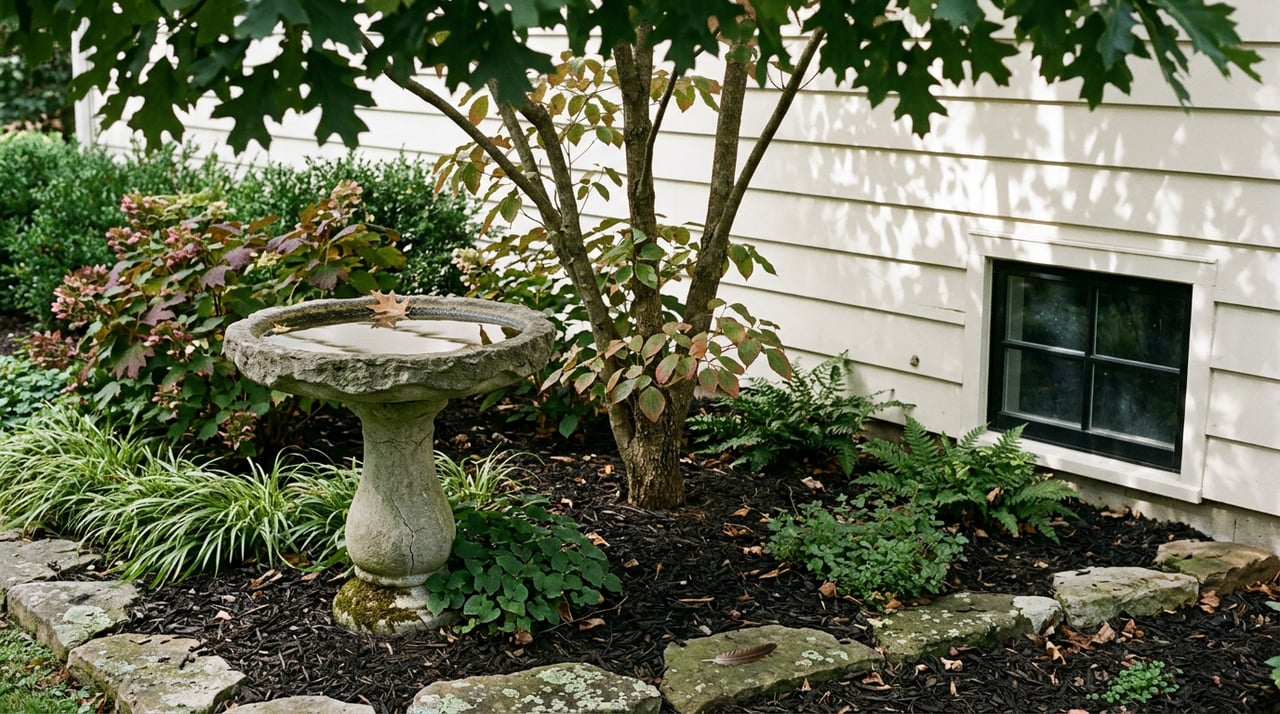
If the ridge is the reason migration lands here, the yards are the reason it stays for more than an afternoon. Advice from Bill Young on how to make a Beverley Hills yard useful to the birds you're trying to see two blocks away is short and specific. Probably the best way to attract the greatest variety of birds is to put out a source of water, because not all birds eat birdseed from feeders but all birds need water for drinking and bathing. A shallow, clean bowl in the shade will out-earn any feeder this fall. Native oak and dogwood, the two species that already define the neighborhood, are the other half of the answer. Both host the caterpillars that fuel a warbler's flight south.
There is also a stewardship angle that shows up every autumn. Volunteer work at the park is coordinated with the Alexandria Department of Recreation, Parks & Cultural Activities, which provides guidance on appropriate trail work as well as supplies of mulch, tools, native trees and shrubs, and neighbors, the North Ridge Citizens' Association, and area Master Naturalists have all pitched in on past projects. A Saturday morning spreading mulch on trail roots is, in the strict sense, a real estate decision. It is one of the reasons the ridge keeps its birds, and its birds keep the ridge worth walking on for the next owners.
The point, at the risk of stating it plainly
The reason to write this post now, in the first week of August, is that fall migration at Monticello is the neighborhood's second season and its most residential one. The spring version is a regional event with visitors. The fall version is a quiet ten-week window that only works if you can walk down at 8:15 on a Thursday, look for twelve minutes, and walk home. That schedule is the definition of living here.
If you're thinking about the ridge from the other side, whether that means finding your first house under the oaks or figuring out how to price the one you've been in for twenty years, the team at The LizLuke Team knows Beverley Hills block by block. Get your free home valuation and we'll start the conversation from what your specific corner of the neighborhood is actually worth this fall.